

What changed
Netlify’s Agent Runners can now ask you questions before it starts building. Agent Runners is Netlify’s prompt-to-app tool: you describe what you want, and an agent writes the code and publishes it as a live, working site or app. You don’t need to set up a coding environment on your own computer, and there’s no separate step where you have to manually push it online. Until now, if your prompt was vague, the agent just guessed at the missing details and started building anyway.
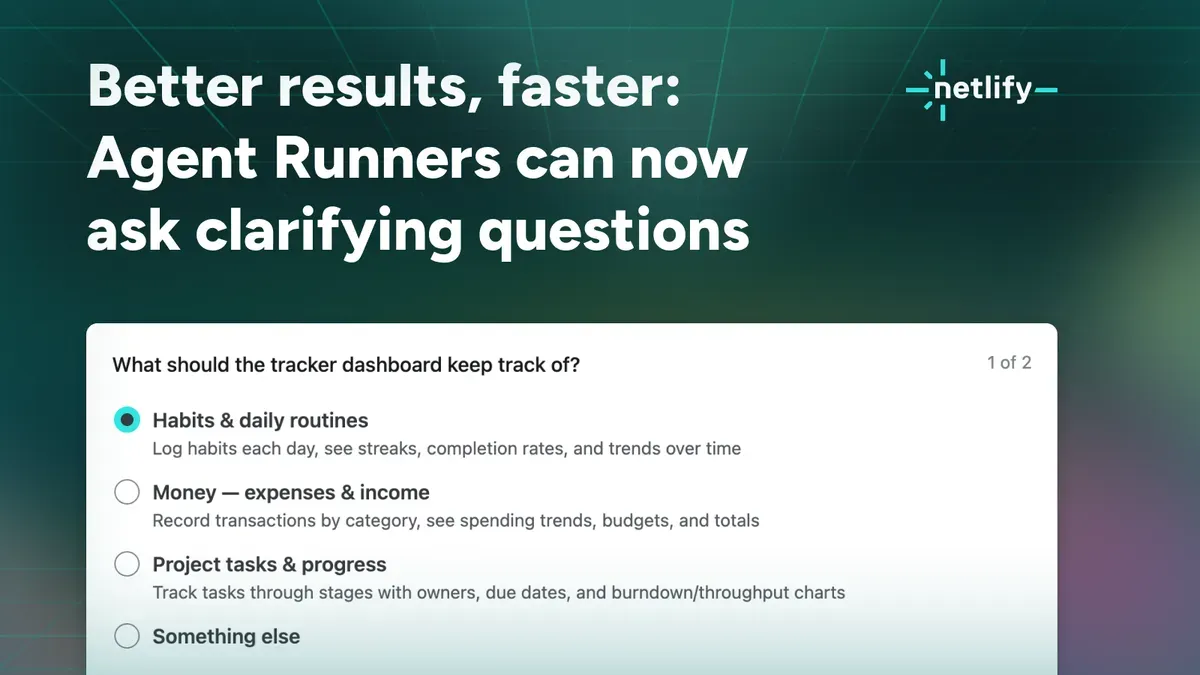
Netlify’s own example is a prompt like “Build a tracker dashboard.” That alone doesn’t say what to track: habits, customer feedback, or something else entirely. With the update, the agent can now pause and ask a handful of questions through what Netlify describes as “an intuitive new UI” before writing any code.
The questions are optional. You can answer the ones you have an opinion on, skip the rest, or skip all of them and let the agent decide on its own, the same way it worked before. You can also add your own context in free text alongside your answers. Once you’re done (or done skipping), the agent builds as usual and gives you a live preview link of the finished app to check before you decide to publish it more widely.
Netlify’s post doesn’t say how many questions a typical prompt generates, whether there’s a cap, or whether this behaves differently across plan tiers. It’s a UX layer on top of the existing build flow, not a separate paid feature by any indication in the announcement.
Why it matters
The pitch is fewer wasted iterations. Netlify meters Agent Runners with credits built into your plan, similar to how a phone data plan works: every task the agent does draws down an allowance instead of getting billed separately. Netlify says answering even a few questions upfront can make the first build “substantially sharper,” which translates directly into money and time. A build that misses your intent means either living with it or spending more credits on a fix. Asking a few questions before writing any code is cheaper than writing the wrong code and rewriting it.
This is a small but telling shift in how these tools behave. Prompt-to-app builders have mostly competed on speed: how fast can you go from an idea to a deployed app. Pausing to ask questions trades a few seconds of upfront friction for a better shot at getting the first build right, which matters more once people are shipping real, credit-metered projects instead of just demos.
Who should care
This is most useful if you tend to write short, underspecified prompts and let Agent Runners fill in the gaps, or if you’ve been burned by a first build that needed several rounds of fixes to match what you actually wanted. It matters less if you already write detailed, specific prompts, since you’re less likely to trigger many clarifying questions in the first place.
What builders should do next
Test it against your own habits before deciding it’s a step you should always use. Pick a project idea you’d normally describe in one short sentence, the kind that would trigger clarifying questions. Run it twice: once answering the clarifying questions Netlify’s agent asks, and once skipping all of them so the agent guesses, the way Agent Runners worked before this update.
Compare two things: how many follow-up prompts or edits it takes after that first live preview to reach the app you actually wanted, and roughly how much time that cleanup takes. If answering the questions upfront cuts your follow-up edits meaningfully, build the habit of answering them. If both paths land you at the same result with the same effort, skipping them and building fast is still the better default for you.
End of article